Stretching Yourself Into a Plateau: The Mobility Myth Holding Climbers Back
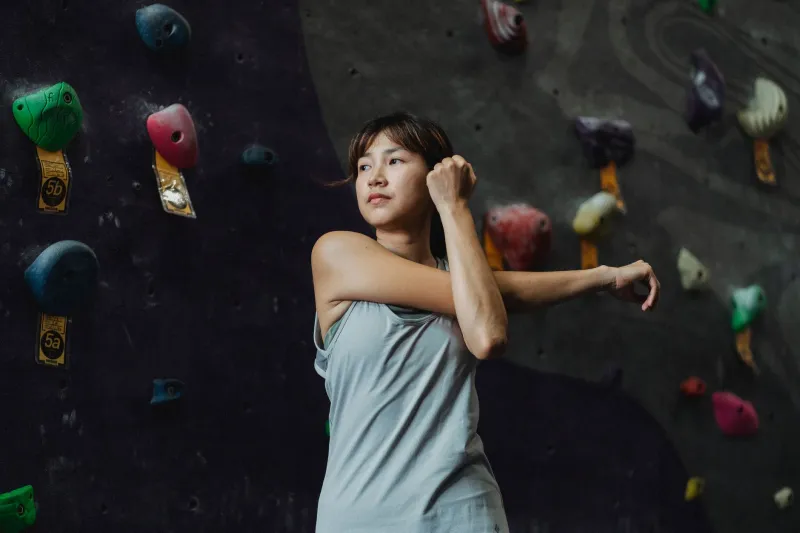
Walk into any climbing gym on a Tuesday night and you'll spot them — the folks who show up early, roll out a mat, and spend twenty minutes folding themselves into positions that would make a gymnast wince. They're dedicated. They're consistent. And a surprising number of them have been climbing the same grades for two, sometimes three years running.
That's not a coincidence.
The climbing community has developed a complicated love affair with flexibility. Yoga class attendance is practically a badge of honor. Instagram is full of climbers doing deep hip openers and hamstring stretches with the caption "mobility work is climbing work." And sure, there's truth buried in there — but the full picture is a lot messier, and pretending otherwise is keeping a lot of capable climbers stuck.
Mobility and Stability Are Not the Same Thing
This is where the conversation usually goes sideways. Mobility — your ability to move a joint through its range of motion under control — is genuinely useful for climbing. Flexibility, in the passive sense, is something different. It just means your tissues can lengthen. A joint that's flexible but not stable is essentially a liability on the wall.
Think about what actually happens when you're stemming a wide crux on a granite slab in Yosemite, or flagging out to hold a balance move on a steep sport route in the Red River Gorge. Your muscles aren't just stretching — they're contracting at end range, managing load, resisting collapse. That requires strength through a full range of motion, not just the ability to passively reach that range on a yoga mat.
When climbers prioritize stretching without building corresponding strength, they create what physical therapists sometimes call "passive hypermobility" — joints that move farther than the surrounding musculature can actually support. On the wall, that shows up as wobbly ankles on small footholds, unstable shoulders under dynamic movement, and hips that drop instead of hold position on high-step moves.
When Stretching Actually Works Against You
Here's the part nobody wants to hear: excessive static stretching before climbing can temporarily reduce the force output of your muscles. There's a solid body of research on this — prolonged static holds before activity dial down the neural drive to the muscle, which means your fingers, forearms, and shoulders are measurably weaker right after a long stretch session than they would have been otherwise.
For a sport where the margin between sending and falling can be a single degree of body position, that matters.
Beyond pre-climb prep, there's a longer-term issue. Climbers who spend a disproportionate amount of training time on passive flexibility — without matching that work with loading the tissues in their newly acquired ranges — often develop a kind of "flexibility without ownership." They can get into a position, but they can't do anything useful once they're there. The high step feels accessible in warm-up but collapses under load when it actually counts.
So What Flexibility Actually Matters?
Not all range-of-motion work is created equal, and the targets that matter really do depend on your climbing style and body type.
For slab and technical face climbers, hip external rotation and ankle dorsiflexion are genuinely worth developing — but through loaded exercises like deep squats, step-ups, and hip-hinge variations, not just passive pigeon pose holds. You want your hips to open actively when you weight a high foot, not just when you're lying on a mat.
For boulderers and steep sport climbers, shoulder health is the bigger priority. Overhead range is important, but what you really need is control at the end of that range — rotator cuff strength, scapular stability, and the ability to resist unwanted movement when you're pulling hard through a lock-off. Passive shoulder stretching without rotator cuff loading is a recipe for impingement, not performance.
For taller climbers with longer limbs, the flexibility demands are often lower than assumed. Long-limbed climbers can frequently reach holds without needing extreme hip opening — what they need is body tension and the ability to keep their center of gravity tight. Chasing flexibility they don't need can actually make their movement sloppier.
For shorter climbers, hip flexibility can be more genuinely limiting — but again, the goal is active control, not passive range. If you can't fire your glute at the top of a high step, getting deeper into that step doesn't help you.
Rethinking the Warm-Up
None of this means you should stop moving before you climb. Dynamic warm-up work — leg swings, arm circles, hip circles, light movement that takes joints through range without long passive holds — is legitimately useful. It gets blood moving, wakes up the neuromuscular system, and prepares tissues for load without the performance-dampening effect of prolonged static stretching.
Save the longer, passive flexibility work for after sessions, or on rest days. That's when it can genuinely help with recovery and slowly build range over time — without compromising what you need when you're actually on the wall.
The Mental Side of the Flexibility Trap
There's something worth naming here that goes beyond the physical. Stretching feels productive. It's measurable — you can see yourself getting closer to the floor, folding deeper, reaching further. That tangible sense of progress is psychologically satisfying in a way that the slower, less visible gains from strength training or technique work often aren't.
For climbers who are feeling stuck or frustrated, flexibility work can become a kind of safe harbor. It's not failing. It's not falling off the same move again. It's doing something. That's not nothing — but it can become a way of avoiding the harder, more uncomfortable work that actually breaks plateaus.
If you've been spending more time on your mat than on the wall lately, it's worth asking yourself honestly whether that's serving your climbing or just making you feel like it is.
Finding the Right Balance
The goal isn't to abandon mobility work — it's to be smarter about it. Spend time on the ranges of motion that your climbing style actually demands. Build strength through those ranges, not just passive access to them. Warm up dynamically, cool down with static work if you want, and keep your flexibility training proportional to the rest of your training load.
Climbing is a strength sport that requires mobility, not a flexibility sport that requires some strength. Once you internalize that distinction, the training decisions start to make a lot more sense — and the plateaus tend to start cracking.