Your Feet Are Doing the Work Wrong: The Overlooked Skill That Unlocks Your Next Grade
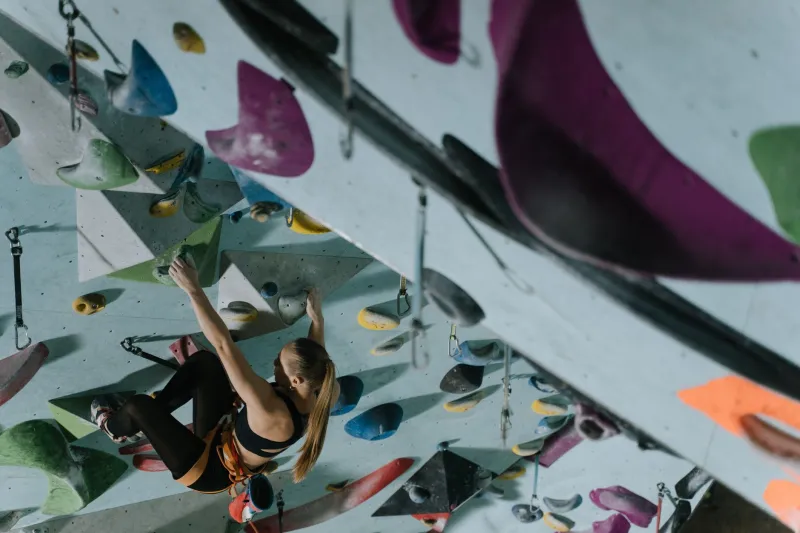
Here's a scene that plays out at climbing gyms across the country every single day. A climber falls off a route, shakes out their forearms, and immediately starts wondering whether they need to do more hangboard sets. Maybe more pull-ups. Maybe a better pre-workout. What almost never crosses their mind? The way their feet are smearing, skating, and generally doing whatever they want on every hold below the waist.
We are, as a culture, obsessed with the upper body. It's not entirely irrational — your hands are the things touching the rock at the crux, your fingers are screaming, your forearms are pumped. The feedback loop points upward. But the climbers who actually move well? Watch their feet. Watch how deliberate, how quiet, how precise every placement is. That's not an accident. That's a trained skill, and most of us have left it almost completely undeveloped.
Why Your Brain Ignores Your Feet
There's a cognitive reason this happens, and it's worth understanding before you try to fix it. When you're on a hard move, your attention narrows. Psychologists call this attentional tunneling — your brain prioritizes the most immediate threat, which feels like the hold your hand is reaching for. Your feet, operating lower and further from your visual focus, get delegated to autopilot.
The problem is that autopilot footwork is almost always sloppy footwork. Your feet end up somewhere on the hold rather than exactly where they need to be. You push off the edge of your shoe instead of the tip. You weight a foot before your hips are in position to use it. None of this feels catastrophic in the moment — until you're pumped, and every wasted calorie of energy from poor foot mechanics catches up with you at once.
This is actually a mental training issue as much as a physical one. Reprogramming your footwork means expanding your attentional field under stress — learning to stay aware of your lower body even when everything above the waist is screaming for your focus.
The Real Cost of Arm-Dependent Climbing
Let's talk about what sloppy footwork is actually costing you — because it goes beyond just climbing grades.
When your feet aren't trustworthy, your hands compensate. You grip harder to feel secure. You pull more aggressively through moves your legs could be powering. Over time, this creates a chronic overload pattern in your fingers, tendons, and shoulders. A huge percentage of climbing injuries — pulley strains, shoulder impingement, elbow tendinopathy — are at least partially downstream of inefficient movement mechanics that started at the feet.
Beyond injury risk, there's the longevity question. Climbers who develop elite footwork early tend to keep climbing hard well into their 40s and 50s. They're not grinding their connective tissue into dust on every session. They're moving efficiently, conserving energy, and letting their skeleton do work that their muscles don't have to.
And then there's the grade ceiling. If you climb 5.11 and want to climb 5.12, you might assume the answer is stronger fingers. Sometimes it is. But often, the actual ceiling is a movement efficiency problem — and footwork is the biggest single variable in that equation.
What Precise Footwork Actually Looks Like
Elite footwork has a few defining characteristics that are worth naming clearly.
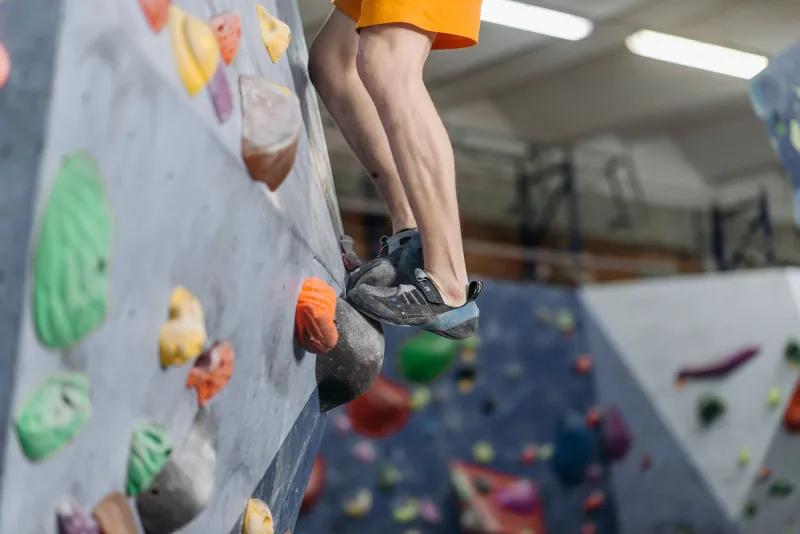
Intentional placement. Every foot goes somewhere on purpose. Not approximately on a hold — exactly on a hold, with the tip of the shoe on the precise point that maximizes friction and leverage. This requires slowing down your movement enough to actually look at your feet, especially when learning.
Weight transfer timing. Good footwork isn't just about where your foot lands — it's about when you commit weight to it. Weighting a foot before your hips are positioned over it is like trying to do a push-up with your hands in the wrong place. The mechanics are off from the start.
Silent feet. This is a useful heuristic: if your feet are making noise when they hit holds, you're moving too fast and too imprecisely. Quiet feet are a byproduct of deliberate, controlled placement. Noisy feet are a symptom of autopilot.
Trusting the smear. A lot of climbers, especially those coming from gym-heavy backgrounds, are psychologically uncomfortable with smearing. They want a defined edge to stand on. But learning to trust friction — really trust it — opens up an enormous range of movement options, particularly on slab and technical face climbing.
Drills That Actually Rewire Your Instincts
Talking about footwork doesn't change it. You need repetition under conditions that force your attention downward. Here are a few approaches that work.
Silent feet drill. Pick a route two or three grades below your limit. Climb it with the explicit rule that your feet cannot make any sound on contact. This single constraint forces a level of deliberateness that most people have never experienced. Do this regularly, and the habit starts to transfer to harder climbing.
Feet-first climbing. Before you move a hand, find your next foot placement. This reverses the typical attention pattern and forces your brain to process the lower half of your body as the primary mover. It feels awkward at first, almost unnatural. That discomfort is the rewiring happening.
Tape a target. Put a small piece of tape on a hold and practice placing the exact tip of your shoe on it, over and over. This sounds almost too simple, but proprioception — your body's sense of where its parts are in space — is trainable. Specific, repetitive practice builds the neural pathways that make precise placement automatic.
Climb in socks on easy terrain. Counterintuitive, but effective. Removing the structure of your climbing shoe forces you to feel the rock (or hold surface) directly and develop sensitivity in your footwork. A few laps on a slab in socks will tell you more about your foot mechanics than hours of normal climbing.
The Mental Shift That Makes It Stick
Here's the thing about footwork improvement: the physical drills only work if you also change the story you're telling yourself on the wall. As long as your internal narrative is I need to be stronger to climb this, you'll keep throwing everything at your upper body. The shift happens when you start asking where are my feet right now? as a reflex — not just when things are going wrong, but constantly, as a baseline awareness.
This is where the mental training angle becomes central. Expanding your attentional field under stress is a learnable skill. Mindfulness practices, visualization, even just regular check-ins during easy climbing can help you build the habit of whole-body awareness rather than crisis-mode tunnel vision.
Climbing smarter doesn't always mean training harder. Sometimes it means looking down.