Why Watching Other Climbers Might Be Making You Worse
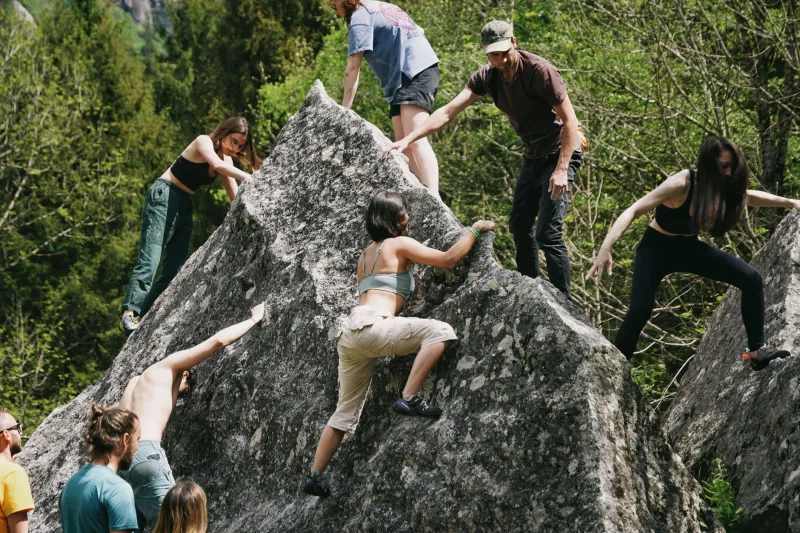
You're at the crag. Someone two pads over just sent a V8 that's been on your project list for two months. They made it look casual. Now you're trying the same problem and everything feels harder than it did twenty minutes ago.
Or you're on your couch watching a climbing edit, and by the end of it you feel simultaneously inspired and kind of defeated—like the gap between where you are and where you want to be just got bigger.
Both of those experiences are extremely common. Neither of them is helping you climb better.
The Brain Is Bad at Context
Here's the core issue: your brain is wired to use social comparison as a calibration tool. It's an old system, and in most of human history it was useful—watching what others could do gave you accurate information about what was possible in your environment.
The problem is that your brain runs that same software whether the comparison is fair or not. Watch someone who's been climbing for fifteen years send a route you've been working for six weeks, and your nervous system registers it as a data point about your own potential. It isn't one. But try telling that to the part of your brain that just decided you're behind.
This is why the comparison trap is so insidious. It doesn't feel like a cognitive distortion. It feels like accurate information.
What Social Media Actually Shows You
Let's talk about the feed, because it's where most American climbers are spending a significant chunk of their climbing-adjacent time.
What climbing content on Instagram, YouTube, and TikTok systematically shows you: elite performance, aesthetic movement, successful sends, extraordinary locations, and the moments just after hard things are accomplished.
What it doesn't show you: the eighteen months of failed attempts before the send. The two years of base fitness building that made the project possible. The bad days, the tweaked fingers, the sessions where nothing worked. The very ordinary daily training that preceded the extraordinary moment.
You're comparing your full, unedited experience—including all the failure and frustration—against someone else's highlight reel. That's not a fair fight, and it's not useful information about your trajectory.
The In-Person Version Is Subtler and Possibly Worse
At least with social media, you know you're watching a curated version of someone's climbing life. In person at the gym or the crag, the comparison feels more real because it is more real—and that makes it harder to contextualize.
You see someone your age, apparently your build, climbing two grades above you, and your brain immediately starts doing math. What are they doing that you're not? Why aren't you there yet? Are you missing something fundamental?
Maybe. But also: you don't know how long they've been climbing. You don't know their training history, their injury history, their schedule, their coaching situation, or what grades they were climbing two years ago. You're looking at a snapshot and trying to derive a story from it—and the story you derive almost always reflects your own insecurities more than it reflects reality.
There's a Useful Version of Watching
None of this means you should stop watching other climbers. Observation is genuinely one of the most powerful learning tools available—when it's pointed at the right things.
Watching someone move through a crux to understand the sequence? Useful. Watching how an experienced climber reads a route before they leave the ground? Useful. Paying attention to footwork, body positioning, breathing patterns, how someone manages a rest position? All of that is legitimate technical learning.
The shift is from comparison to curiosity. Instead of asking why can they do that and I can't, ask what are they actually doing, and what can I take from it?
That's a completely different cognitive mode. One contracts your sense of what's possible. The other expands your technical vocabulary.
Building Your Own Timeline
One of the more damaging effects of comparison culture in climbing is the false timeline it creates. You start to feel like there's a schedule you're supposed to be on—that climbing 5.12 by year three or sending your first V6 within a certain window is the normal pace, and anything slower means you're falling behind.
There is no schedule. Climbing progression is shaped by a nearly infinite number of variables: when you started, how often you climb, what your athletic background is, whether you've had injuries, the quality of your instruction early on, the climbing environment you have access to, and how your particular body responds to training loads. None of those variables are the same for any two climbers.
The only timeline that matters is the one between where you were and where you are now. That's the only comparison that contains actual information about your development.
Practical Ways to Break the Pattern
If you recognize yourself in this, here are a few things that actually help:
Keep a climbing journal. Not for tracking grades—for tracking what you worked on, what you learned, and what felt different. It's much harder to feel stuck when you have a written record of what you've been figuring out.
Audit your feed. If certain accounts consistently make you feel worse about your climbing rather than more curious about it, unfollow them. This isn't avoidance—it's curation. Your mental diet matters.
Set process goals instead of grade goals. Grade goals are almost entirely comparison-driven. Process goals—work on hip positioning, practice falling, try a new style of movement—keep your attention on your own development.
Talk about it. Most climbers feel this way sometimes. The comparison trap thrives in silence. Naming it out loud, with a training partner or a coach, takes some of its power away.
The Climber You're Actually Competing With
There's a version of you from six months ago who couldn't do the things you can do now. That's the only opponent worth paying attention to.
Every climber on the wall around you is dealing with their own ceiling, their own history, their own set of things they're quietly working through. Their journey isn't a benchmark for yours. It's just a different story happening in the same place.
Watch them when it helps you learn. Let them go when it doesn't.