Why Your Head Is the Crux: Breaking Through the Mental Barriers That Kill Your Redpoint
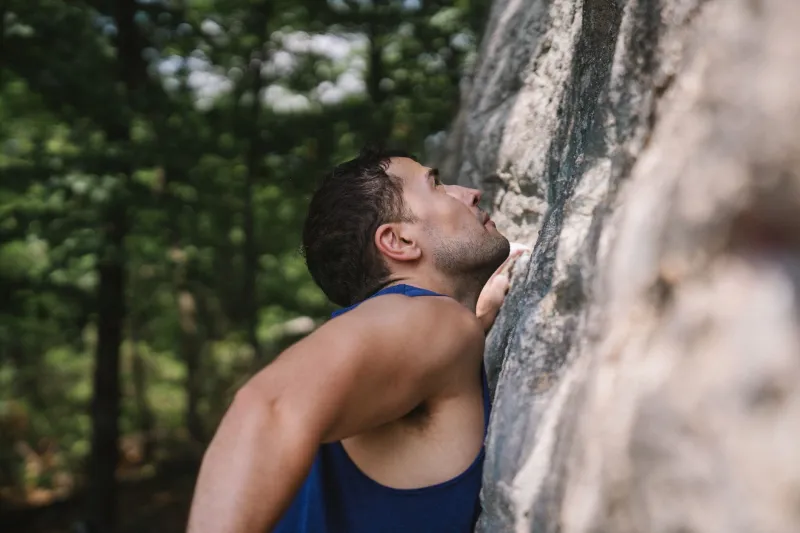
When Your Body Is Ready But Your Brain Isn't
There's a specific kind of frustration that every climber knows. You've dialed the moves. You've linked every section in pieces. You've even stuck that gnarly undercling at the third bolt on a cold morning when your skin felt like sandpaper. By every measurable standard, you can do this climb.
And then you get on it for the redpoint attempt—and something falls apart.
Maybe you rush through the crux. Maybe you barn-door off a hold you've stuck a hundred times. Maybe you simply freeze, hanging on the wall with your forearms pumping and your mind completely blank. Whatever form it takes, the experience is the same: your body had the goods, but your head didn't show up.
This isn't a fitness problem. It's a mental game problem. And honestly? It's one of the most underaddressed parts of climbing performance in the US climbing community.
The Perfectionism Trap
One of the sneakiest saboteurs in redpointing is perfectionism—and it doesn't always look the way you'd expect. You might not think of yourself as a perfectionist. But if you've ever bailed off a route because you "didn't feel warmed up enough," or talked yourself out of a burn because "the conditions weren't perfect," you've met the beast.
Perfectionism in climbing shows up as an endless search for the ideal attempt. The perfect temperature. The perfect skin. The perfect number of rest days. The perfect mental state. And the cruel irony is that chasing perfection guarantees you'll never actually try—because perfect conditions don't exist.
Sports psychologist Dr. Noa Kageyama, who works with elite performers across multiple disciplines, calls this "achievement avoidance." The logic is twisted but real: if you never fully commit to an attempt, you never fully fail. Your ego stays protected. But your climbing stays stuck.
The fix isn't to lower your standards—it's to separate preparation from performance. Do your diligence in the working phase. But when it's time to go for the send, commit to the attempt you have, not the attempt you wish you were having.
Fear Is Smarter Than You Think
Fear gets a bad reputation in climbing circles. We talk about "crushing" it, "overcoming" it, "pushing past" it. But fear isn't the enemy—it's information. The problem is when we misread what it's telling us.
On a redpoint, fear often isn't about the physical danger of the route (especially on sport climbs with bomber protection). It's about something more socially complex: the fear of being seen to fail. The fear of having told your friends "I'm going for the send today" and coming up short. The fear of confirming some story you carry about yourself—that you're not good enough, not strong enough, not a real climber.
When you identify that as the actual fear, you can start working with it instead of just white-knuckling your way through it.
One technique that works well here is what climbers and coaches sometimes call "reframing the stakes." Before your attempt, ask yourself: what's actually at risk here? Not abstractly—get specific. If you fall, what literally happens? You hang on the rope. Your friends see you fall. You try again another day. When you lay it out plainly, the psychological stakes shrink to a more manageable size.
The Pressure Cooker Effect: When Trying Too Hard Backfires
Here's something counterintuitive: caring too much about the send can actually make you climb worse.
When the outcome feels enormous, your nervous system kicks into a heightened state. Cortisol spikes. Muscle tension increases. Your movement—which should feel fluid and automatic after all that practice—suddenly feels effortful and mechanical. You start thinking about moves you've done on autopilot a dozen times, and the moment you consciously think about something your body knows how to do automatically, you disrupt the motor pattern.
This is sometimes called "paralysis by analysis," and it's brutally common on high-stakes redpoint attempts.
The solution isn't to care less (you can't just turn that off). It's to redirect your focus. Instead of fixating on the outcome—the send, the grade, the validation—anchor your attention to process cues. Specific things you can feel and control in the moment: your breathing at the rest before the crux, the texture of the rock under your fingertips, the deliberate placement of your left foot on that sloper.
Process focus keeps you in your body and in the present. Outcome focus yanks you into an imagined future where you're either celebrating or devastated—and neither of those places is useful when you're 40 feet off the deck.
Real Talk: What Climbers Actually Do
Talk to enough climbers about their sends and you'll start noticing patterns in what actually helped them break through.
Sarah, a 5.12 climber from Colorado who spent a full season projecting a single route at Shelf Road, described her breakthrough this way: "I stopped telling people when I was going for it. The second I made it a public event in my head, I choked. When I just... went climbing and happened to try it, I sent it third attempt."
That's not a fluke. Reducing social pressure by lowering the perceived audience—even if that audience only exists in your head—can dramatically change how you perform.
Marcus, a gym rat from Brooklyn who made the jump to outdoor sport climbing, found that building a consistent pre-send ritual helped him most. "I do the same thing every time I tie in for a real attempt. Same breathing pattern, same visualization, same little phrase I say to myself. It's like a signal to my brain that it's time to climb, not time to freak out."
Pre-performance routines work because they create a bridge between your calm, practiced state and the heightened state of the actual attempt. They're not superstition—they're neurological anchors.
Building Your Mental Toolkit
If you want to start working on the mental side of your redpointing game, here are a few concrete places to start:
Practice falling deliberately. If fall fear is part of what's freezing you up, desensitize it on purpose. Take practice falls at the clip, above the clip, in the crux. Make falling boring.
Use the "so what" technique. When anxiety about the outcome spikes, run through the worst-case scenario and ask yourself "so what?" repeatedly until you reach something genuinely manageable. It usually takes about three rounds.
Establish a pre-attempt ritual. Keep it short—60 to 90 seconds. Breathing, visualization, a word or phrase. Do it every time, not just on the big attempts.
Debrief without judgment. After every attempt, good or bad, spend two minutes reflecting on what you controlled well—not just what went wrong. This builds confidence incrementally instead of eroding it.
Separate your identity from the grade. You are not a 5.12 climber or a 5.13 climber. You're a climber who's working on a route. Grades are data, not identity.
The Send Is Already Inside You
Here's the thing nobody tells you enough: if you've done the work, the send isn't about doing something new. It's about getting out of your own way long enough to let your body do what it already knows how to do.
That's not a small thing. Getting out of your own way is genuinely hard. But it's trainable—just like your contact strength or your footwork. The mental game responds to deliberate practice, and every time you commit to a real attempt with full presence and zero guarantee, you're building exactly that.
Your project is waiting. Your body's ready. Now let's get your head there too.